

Walk through any Amish community and you will notice the same detail on almost every man: suspenders, not a belt. It is not a coincidence and it is not a fashion trend. The choice is written into the Ordnung, the unwritten set of church rules that governs how Amish men and women dress, and it comes down to one word that shapes nearly everything about plain dress: humility.
Belts, in the Amish view, exist mostly to be seen. A buckle draws the eye, and drawing the eye to yourself runs against the entire point of plain dress. Suspenders do the same job of holding up a pair of trousers without asking anyone to look at them. That is the short answer. The longer answer touches on faith, a wider tradition shared with other Plain communities, the actual construction of Amish trousers, and a few surprising local customs that most outsiders never hear about.
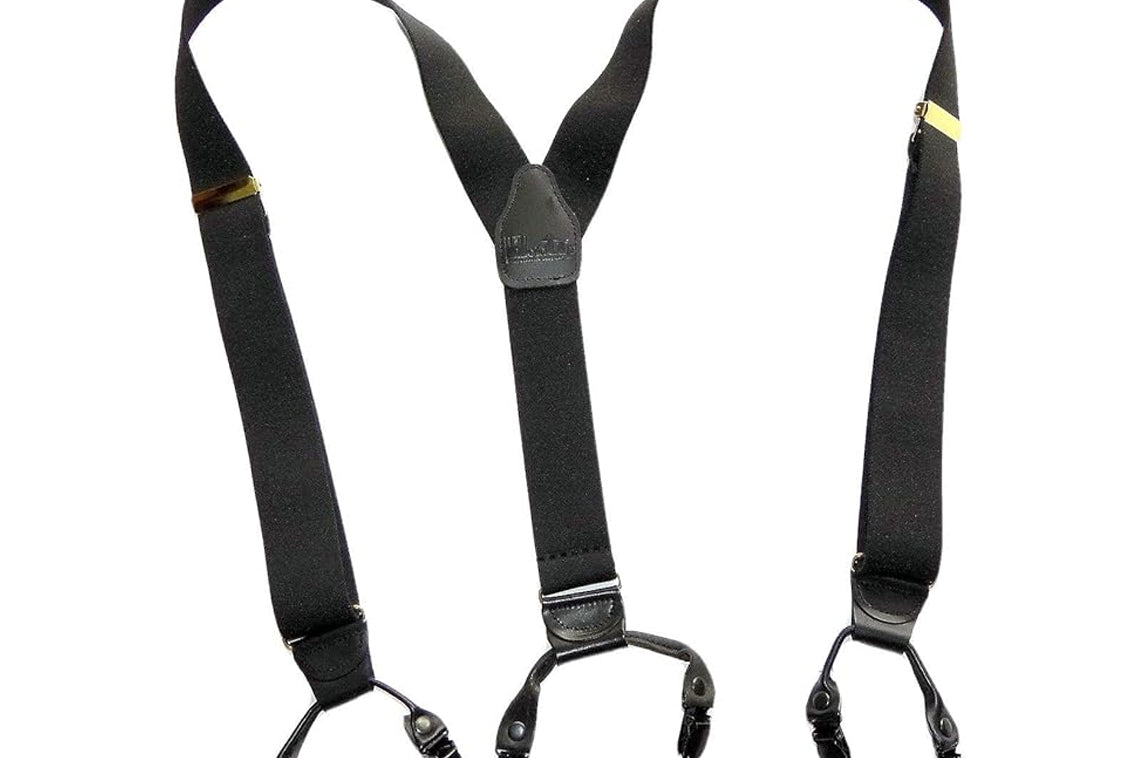
Want that same plain, no-fuss look for yourself? The All Black Casual Series Y-back suspenders share the same understated silhouette, a solid color, a plain leather crosspatch, and nothing on them designed to attract attention.

The Religious Reasoning Behind Suspenders Over Belts
Amish dress codes trace back to a concept called Gelassenheit, roughly translated as yielding to God's will rather than to personal preference or vanity. Under that principle, anything that calls attention to the individual, rather than to the community and its shared values, is discouraged.
According to Amish America, a long-running resource on Amish culture written with input from Amish community members themselves, suspenders fit naturally into that framework because they are purely functional. A strap over each shoulder holds the pants up. There is nothing more to it, and that is exactly the point.
This same logic runs through the rest of Amish clothing. If you have read our history of suspenders, you already know suspenders were the default way to hold up trousers long before belts became common in mainstream fashion, and older sources still refer to them by their original name, which our piece on why suspenders are called braces explains in more detail.
Where most men moved on to belts over the twentieth century, a change we cover in our piece on why men stopped wearing suspenders, Amish communities held onto the older, plainer standard on religious grounds rather than habit.
The Wider Anabaptist Tradition Behind the Practice
 Suspenders over belts is not an Amish invention on its own. It traces back to the Anabaptist movement the Amish descend from, which began in Zollikon, Switzerland in 1525 and was formalized two years later in the Schleitheim Confession. Mennonites, Hutterites, and the Amish all grew out of that same root, and all three groups share a general commitment to modest, plain dress, even though the strictness of the rules varies widely between them today.
Old Order Mennonites, the more traditional branch of the Mennonite church, dress in a way that looks strikingly close to Amish plain dress, suspenders included, and for the same stated reason: belts are considered too showy for daily wear. Where the groups diverge is on the far end of the spectrum.
Mainline, more assimilated Mennonite congregations dress like anyone else and have long since dropped the suspenders-only rule, while the Amish, organized into local Old Order, New Order, and Beachy affiliations, have largely kept plain dress as a matter of church order rather than personal choice. Hutterite communities follow a related but separately governed dress code with its own local variations.
The suspenders-not-belts detail, in other words, is a shared Anabaptist habit that the Amish simply held onto more consistently and more visibly than most of their sister communities.
Why Belts Specifically Are Avoided
It is not that belts fail to do the job. Amish objections to belts are almost entirely about what a belt communicates rather than what it does. A buckle is decorative hardware. It can be large, shiny, engraved, or branded, and any one of those qualities turns a practical item into a small display of personal style or status.
Zippers and other modern fasteners face similar suspicion in many Amish communities for the same reason: they are seen as unnecessary flash rather than necessity, which is why many Amish men's trousers close with buttons instead.
Suspenders sidestep the problem entirely. A plain strap in a dark, solid color does not compete for attention the way a belt buckle can. For a fuller comparison, our guide on suspenders versus belts lays out practical differences that apply well beyond Amish communities, from weight distribution to fit.
What Amish Trousers and Suspenders Actually Look Like
Amish trousers are made from plain, dark broadcloth or wool, typically in black, navy, or dark brown, and are cut in a style known as broadfall trousers. Rather than a center zipper or button fly, a broadfall front opens as a flap that buttons at the sides of the waist, a construction detail that predates the zipper entirely and one more reason a belt buckle at the center front never became part of the look.
The suspenders worn with them follow the same rule as the trousers: solid color, no pattern, no branding, and a straightforward attachment. Our breakdown of suspender types covers the button-on and clip-on options available today, and Amish suspenders lean toward the plainest end of that spectrum by design.
If you want a solid, understated color, the Java Brown Y-back suspenders offer the same conservative, one-color-does-it-all approach in a warmer tone that pairs with almost any trouser color.

One Suspender, Two Suspenders, or None: Local Variation
One detail surprises most people who ask about this topic. In certain conservative Amish groups, including the Byler Amish of Big Valley, Pennsylvania, men traditionally wear only a single suspender rather than a pair. According to local accounts documented by Amish America, the practice began as an even more conservative response within that community's own Ordnung, a way to tolerate suspenders while keeping the look as understated as possible.
Other Amish affiliations, including the Nebraska Amish, take the opposite approach and skip suspenders altogether, opting for other simple ways to keep trousers in place. Dress rules are set locally by each church district rather than by any single Amish authority, so what holds true in one settlement will not always hold true in the next.
The Comfort and Practical Advantage Behind the Tradition
 Religious reasoning aside, suspenders have stuck around for a practical reason in a community built on manual, physical labor. Amish men spend long days farming, building, and working with their hands, and a belt cinched tight enough to hold up work trousers can dig in and restrict movement over a full day of bending and lifting. Suspenders carry that same weight from the shoulders instead, which is a large part of why they remain the more comfortable option for anyone doing sustained physical work, plain dress or not.
In that sense, the Amish preference for suspenders aligns with a broader, faith-independent case for suspenders over belts that shows up across trades from construction to farming. The reasoning is different, but the outcome, a strap that holds trousers up without fighting the wearer's movement, is the same.
Frequently Asked Questions
Do all Amish men wear suspenders?
Most do, but each local church district's Ordnung sets the rules, so there is some variation. A few conservative groups, including the Nebraska Amish, do not wear suspenders at all and instead use other simple methods to hold up their trousers.
Why don't Amish men wear belts?
Belts, and buckles in particular, are seen as decorative rather than purely functional, which conflicts with the Amish commitment to humility and plain dress. Suspenders do the same job without drawing attention to the wearer.
What color are Amish suspenders?
Amish suspenders are almost always a single solid, dark color such as black, navy, or brown, matching the plain broadcloth or wool trousers they are worn with. They avoid patterns, bright colors, and visible branding.
Is it true some Amish men wear only one suspender?
Yes, in certain conservative communities such as the Byler Amish of Big Valley, Pennsylvania. The practice reflects that group's local Ordnung and its particularly strict approach to keeping dress as plain as possible.
Do Mennonites avoid belts for the same reason as the Amish?
Old Order Mennonites generally do, following the same Anabaptist tradition of plain dress that the Amish descend from. More assimilated, mainline Mennonite congregations have largely dropped the rule and dress in contemporary clothing, belts included.
What are broadfall trousers?
Broadfall trousers are the traditional style of pants worn by Amish men, with a flap front that buttons at the sides of the waist instead of a center zipper or button fly. The style predates modern fasteners, which is why suspenders, rather than a belt, are the natural way to hold them up.